


EMRL [EMRL] Prof. Kyu-Young Park: Concurrently Achieving 10 mAh cm and Ultralow Binder Content via Active…
페이지 정보

작성자 최고관리자
댓글 0건 조회 1,179회 작성일 2026-01-12 16:52
본문
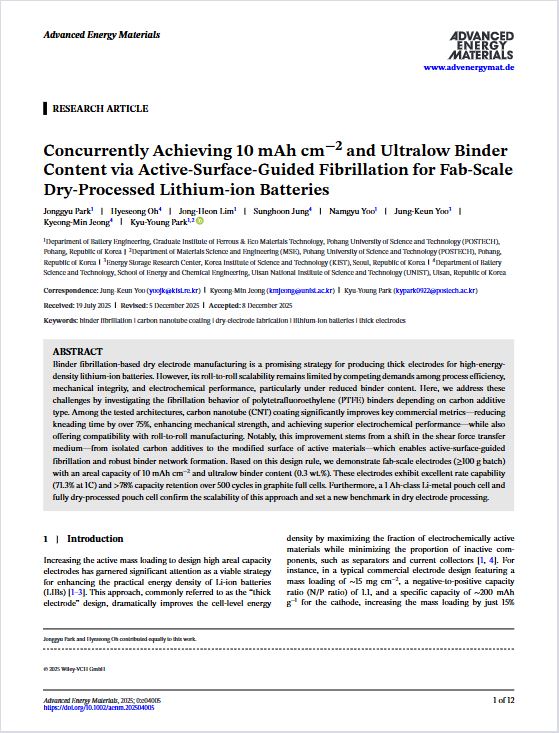
Binder fibrillation-based dry electrode manufacturing is a promising strategy for producing thick electrodes for high-energy-density lithium-ion batteries. However, its roll-to-roll scalability remains limited by competing demands among process efficiency, mechanical integrity, and electrochemical performance, particularly under reduced binder content. Here, we address these challenges by investigating the fibrillation behavior of polytetrafluoroethylene (PTFE) binders depending on carbon additive type. Among the tested architectures, carbon nanotube (CNT) coating significantly improves key commercial metrics—reducing kneading time by over 75%, enhancing mechanical strength, and achieving superior electrochemical performance—while also offering compatibility with roll-to-roll manufacturing. Notably, this improvement stems from a shift in the shear force transfer medium—from isolated carbon additives to the modified surface of active materials—which enables active-surface-guided fibrillation and robust binder network formation. Based on this design rule, we demonstrate fab-scale electrodes (≥100 g batch) with an areal capacity of 10 mAh cm−2 and ultralow binder content (0.3 wt.%). These electrodes exhibit excellent rate capability (71.3% at 1C) and >78% capacity retention over 500 cycles in graphite full cells. Furthermore, a 1 Ah-class Li-metal pouch cell and fully dry-processed pouch cell confirm the scalability of this approach and set a new benchmark in dry electrode processing.
관련링크
- 이전글[ICMEL] Prof.Kyoungdoc Kim: Solidification microstructure and elemental segregation in laser-based powder bed fusion additively manufactured IN738LC Ni-based superalloy 26.02.12
- 다음글[EMRL] Prof. Kyu-Young Park: High-Entropy Doped KTiOPO4-Type Vanadium-Based Fluorophosphate Cathodes for High-Energy Sodium-Ion Batteries 26.01.12
댓글목록
등록된 댓글이 없습니다.