


SECL [SECL] Prof.Minah Lee: A unified framework for path-dependent order-to-disorder phase evolution in L…
페이지 정보

작성자 최고관리자
댓글 0건 조회 8회 작성일 2026-07-23 11:07
본문
Abstract
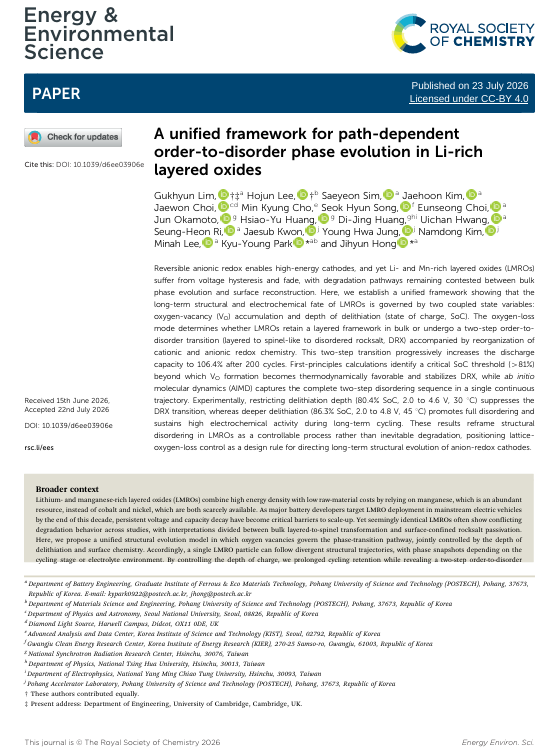
Reversible anionic redox enables high-energy cathodes, and yet Li- and Mn-rich layered oxides (LMROs) suffer from voltage hysteresis and fade, with degradation pathways remaining contested between bulk phase evolution and surface reconstruction. Here, we establish a unified framework showing that the long-term structural and electrochemical fate of LMROs is governed by two coupled state variables: oxygen-vacancy (VO) accumulation and depth of delithiation (state of charge, SoC). The oxygen-loss mode determines whether LMROs retain a layered framework in bulk or undergo a two-step order-to-disorder transition (layered to spinel-like to disordered rocksalt, DRX) accompanied by reorganization of cationic and anionic redox chemistry. This two-step transition progressively increases the discharge capacity to 106.4% after 200 cycles. First-principles calculations identify a critical SoC threshold (>81%) beyond which VO formation becomes thermodynamically favorable and stabilizes DRX, while ab initio molecular dynamics (AIMD) captures the complete two-step disordering sequence in a single continuous trajectory. Experimentally, restricting delithiation depth (80.4% SoC, 2.0 to 4.6 V, 30 °C) suppresses the DRX transition, whereas deeper delithiation (86.3% SoC, 2.0 to 4.8 V, 45 °C) promotes full disordering and sustains high electrochemical activity during long-term cycling. These results reframe structural disordering in LMROs as a controllable process rather than inevitable degradation, positioning lattice-oxygen-loss control as a design rule for directing long-term structural evolution of anion-redox cathodes.
관련링크
댓글목록
등록된 댓글이 없습니다.