


EMRL [EMRL] Prof. Kyu-Young Park: Enabling Multielectron Reaction of Polyanionic Cathodes Toward High-Ene…
페이지 정보

작성자 최고관리자
댓글 0건 조회 99회 작성일 2026-01-12 16:47
본문
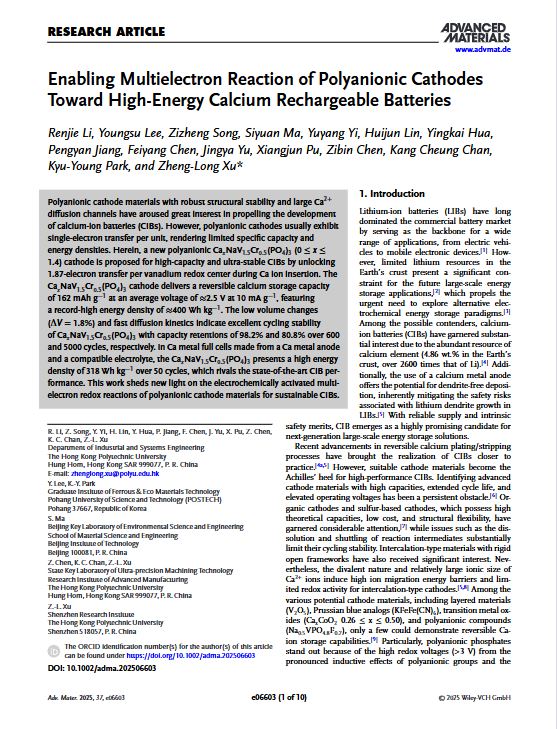
Polyanionic cathode materials with robust structural stability and large Ca2+ diffusion channels have aroused great interest in propelling the development of calcium-ion batteries (CIBs). However, polyanionic cathodes usually exhibit single-electron transfer per unit, rendering limited specific capacity and energy densities. Herein, a new polyanionic CaxNaV1.5Cr0.5(PO4)3 (0 ≤ x ≤ 1.4) cathode is proposed for high-capacity and ultra-stable CIBs by unlocking 1.87-electron transfer per vanadium redox center during Ca ion insertion. The CaxNaV1.5Cr0.5(PO4)3 cathode delivers a reversible calcium storage capacity of 162 mAh g−1 at an average voltage of ≈2.5 V at 10 mA g−1, featuring a record-high energy density of ≈400 Wh kg−1. The low volume changes (∆V = 1.8%) and fast diffusion kinetics indicate excellent cycling stability of CaxNaV1.5Cr0.5(PO4)3 with capacity retentions of 98.2% and 80.8% over 600 and 5000 cycles, respectively. In Ca metal full cells made from a Ca metal anode and a compatible electrolyte, the CaxNaV1.5Cr0.5(PO4)3 presents a high energy density of 318 Wh kg−1 over 50 cycles, which rivals the state-of-the-art CIB performance. This work sheds new light on the electrochemically activated multielectron redox reactions of polyanionic cathode materials for sustainable CIBs.
관련링크
- 이전글[EMRL] Prof. Kyu-Young Park: Characterizing and mitigating chemomechanical degradation in high-energy lithium-ion battery cathode materials 26.01.12
- 다음글[EMRL] Prof. Kyu-Young Park: Origin of Double Ligand Holes and Abnormal Inductive Effect of np6 Elements in Ni-rich Cathodes 26.01.12
댓글목록
등록된 댓글이 없습니다.